How Your 5-Minute Face Routine Should Change With Age (And When)
Quick Answer: The core structure of a 5-minute face (skin, brows, one color point, mascara) stays the same at any age — what changes is product texture: swap matte, heavy-coverage products for dewy, lightweight ones as skin’s natural moisture and texture shift, typically becoming more noticeable through the 30s and 40s.
Your go-to 5-minute face from a decade ago might still take 5 minutes, but if it’s started looking slightly off — cakey in new places, sitting in fine lines it never used to — the routine isn’t broken, the products in it need updating.
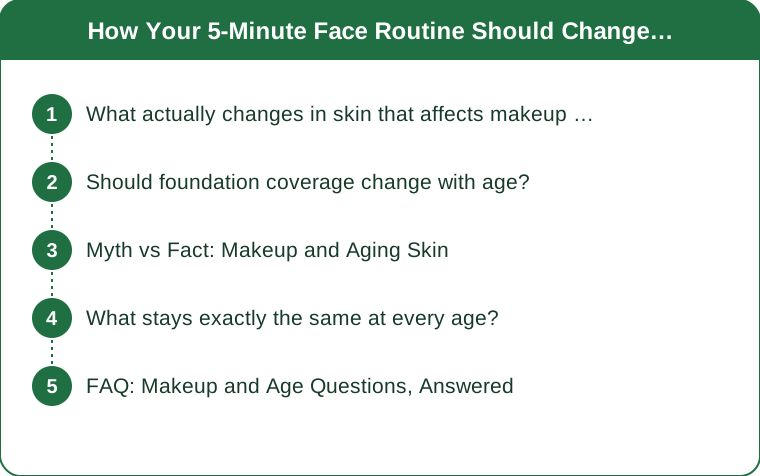
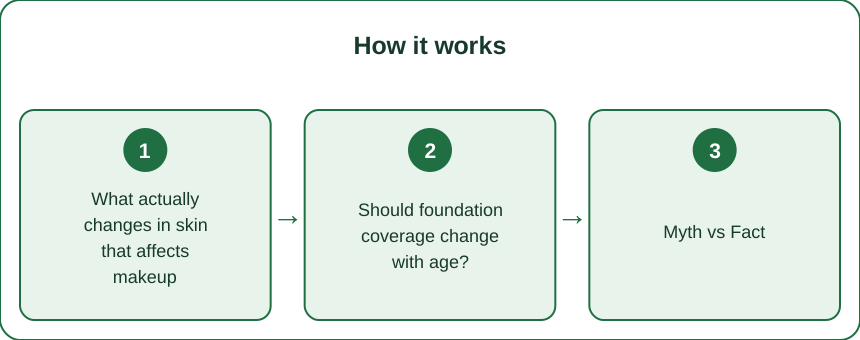
What actually changes in skin that affects makeup application?
Skin naturally produces less oil over time and cell turnover slows, which means matte, full-coverage formulas that looked smooth at 25 can look dry or settle into texture later on. This isn’t about ‘aging skin’ needing more product — often it needs different texture, sometimes less product overall.
The fix is usually formula, not more steps: swapping a matte liquid foundation for a dewy or satin-finish one, or a full-coverage stick for a tinted moisturizer, keeps the same 5-minute routine but changes how it sits on skin.
Should foundation coverage change with age?
Not necessarily upward — many people find lighter coverage with strategic concealer (just where needed, not all over) looks more natural on changing skin texture than a heavy full-face formula, which tends to emphasize texture rather than hide it.
The habit worth adopting: pat, don’t rub, foundation into skin. Rubbing motions drag product into fine lines and settle it there; patting motions let it sit on top more evenly.
Myth vs Fact: Makeup and Aging Skin
Myth: You need more products as you get older. Fact: Often the opposite — fewer, better-suited products (right texture, right finish) outperform adding more steps to compensate.
Myth: Matte finish always looks more ‘put together.’ Fact: On drier or more textured skin, matte finish can emphasize exactly what it’s meant to smooth. A slight dewiness often reads as more polished on mature skin.
Myth: Bold color makes you look older. Fact: A well-chosen lip or cheek color often does the opposite — brightness near the face reads as energy, and it’s frequently the neutral, ‘safe’ shades that can wash skin out.
What stays exactly the same at every age?
Well-groomed brows and defined lashes are the two elements that consistently do the most visual work in a quick routine, regardless of age — they frame the face and don’t rely on skin texture the way base products do.
The overall 5-minute structure (skin prep, base, one color point, brows, lashes) doesn’t need to change either — it’s specifically the formula choices within that structure that benefit from an update every few years as skin shifts.
FAQ: Makeup and Age Questions, Answered
At what age should you switch to dewier formulas?
There’s no fixed age — go by how your current formula looks on your skin now, not a birthday. Some people shift in their early 30s, others later.
Do you need a separate routine for daytime vs evening as you age?
Not necessarily two routines — a single dewy base with a slightly bolder lip or liner swapped in for evening covers most needs without doubling your steps.
Is it worth re-testing your old go-to products periodically?
Yes — skin changes gradually enough that re-testing favorites once a year or so catches formula mismatches before they become a daily frustration.
TL;DR:
- The 5-minute structure stays the same — formula texture is what needs periodic updating
- Dewy or satin finishes often suit changing skin texture better than matte over time
- Fewer, better-matched products beat adding more steps to compensate
- Brows and lashes do consistent visual work at any age
If your quick routine feels off lately, it’s probably a formula update, not a bigger overhaul.
Keep Reading
This article is for general informational and styling purposes only. Fit, sizing, and product availability may vary.