The Five-Minute Face for Days That Start at 55 and Hit 80
Quick Answer: On days with a big temperature swing, build for the warmest part of the day and layer up for the cold morning. Use a lightweight base, set only where you get shiny, and skip heavy cream products that move once it warms up. The key change is order — hydrate more, pigment less, and set selectively rather than all over.
You leave the house at 55°F and your makeup looks perfect. By 2pm it is 80°F, and the base that looked flawless at 7am has slid into your smile lines.
This is an early autumn problem specifically, and it has less to do with your products than with which climate you built for.

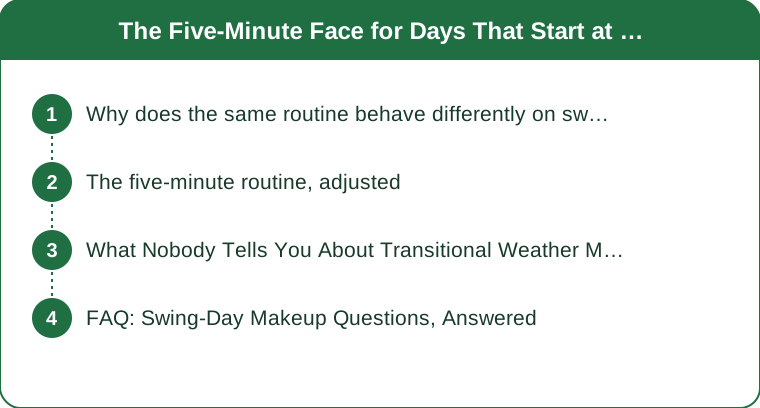
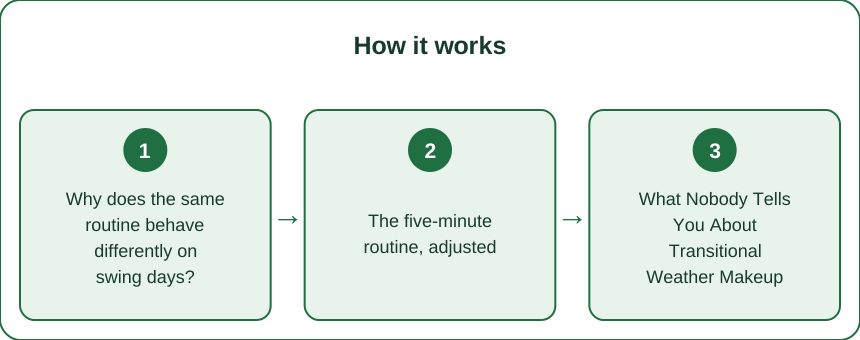
Why does the same routine behave differently on swing days?
Because three things change with temperature, and all of them affect makeup.
1. Your skin’s oil production rises with heat. Sebum production increases as skin temperature climbs, which is why the same base that sat perfectly at 55°F breaks up at 80°F. The makeup did not fail — the surface underneath it changed.
2. Humidity changes how products set. A cool dry morning lets products set firmly. A warm humid afternoon keeps them fluid, and anything that had not fully set is now moving.
3. Cold skin absorbs differently. Applying to cold skin in a chilly bathroom, then warming up an hour later, means the product settled into one surface and then the surface changed shape as capillaries dilated.
The practical implication: you are effectively doing makeup for a climate you will not be in. Build for the warmest part of the day, because that is when it will be under the most stress, and the cool morning will not challenge it either way.
This is the opposite of what most people do instinctively, which is to build for how their skin feels at the moment of application.
The five-minute routine, adjusted
Minute 1 — Prep, and this is where the swing is won. Cleanse or rinse, then a lightweight hydrating layer while skin is still slightly damp. Skip heavy creams on swing days — a rich moisturizer that feels perfect at 55°F becomes a slip layer at 80°F and everything above it moves.
If your skin is genuinely dry, use a hydrating serum plus a light lotion rather than one heavy cream. Hydration and occlusion are different jobs, and on warm afternoons you want the first without much of the second.
Minute 2 — Base, thinner than instinct suggests. A tinted moisturizer or skin tint rather than a full-coverage foundation. Warm afternoons break down heavy bases visibly, and thin bases fail gracefully — they fade rather than separating.
Apply with fingers or a damp sponge, and use less than you think in the center of the face, building only where you want it.
Minute 3 — Selective concealing. Under-eyes and any specific spots. Small amounts, pressed rather than rubbed. This is where a full-coverage product genuinely earns its place, because the area is small.
Minute 4 — Set only where you get shiny. This is the biggest change from a summer routine and from a winter one. A light dusting of powder on the T-zone and around the nose only — not all over. Fully powdering a face on a cool morning leaves it looking flat and dry by afternoon, and does nothing extra for oil control where you do not produce oil.
Minute 5 — Color, chosen for durability. Cream blush on a warm day tends to slide. Powder blush over a set T-zone holds better. Brows, a lash coat, and a lip product complete it.
The one thing to carry: blotting papers rather than more powder. Adding powder on top of afternoon oil is what creates a cakey texture; blotting first and then powdering lightly, if at all, does not.

What Nobody Tells You About Transitional Weather Makeup
Your foundation shade is probably wrong right now. Summer tan fades over four to six weeks, and most people notice too late. Early autumn is the single most common time to be wearing a shade that no longer matches, and it shows most at the jawline. Check in natural light, not bathroom light.
SPF does not become optional. UV exposure drops in autumn but does not disappear, and the habit of skipping it once it stops feeling hot is nearly universal. If your base does not include it, a light SPF under it costs fifteen seconds.
Your skin’s needs change faster than your routine does. The drop in humidity from late summer into autumn tends to make skin drier at exactly the moment people are still using summer’s oil-control products. If your skin suddenly feels tight, the mattifying products that were right in July may now be too much.
Static becomes a hair problem before it becomes a skin problem. The same drier air that changes your skin changes your hair, and a face that looks great with hair stuck to it does not look great.
Layers change your neckline all day. A scarf in the morning and a bare neck by afternoon means base along the jaw and neck gets rubbed off in the morning specifically. Blend down but keep it light there, and expect it to need the most touch-up.
The 3pm check is different in autumn. In summer you are blotting oil. In transitional weather you are more likely dealing with a base that has gone patchy from the humidity swing, and a spritz of water or a hydrating mist plus a press with clean fingers fixes it better than powder does.
FAQ: Swing-Day Makeup Questions, Answered
Should I use a primer on days with a big temperature swing?
If you use one, choose a gripping or hydrating primer rather than a heavy mattifying one. A silicone-heavy primer under a base that will face humidity later can make separation worse, not better.
Is setting spray worth the extra 20 seconds?
On swing days, yes — more than powder. It locks the base without adding the dryness that all-over powdering does, and it holds up better through a warm afternoon.
Why does my makeup look fine at home and patchy in the office?
Usually lighting plus temperature. Office climate control is drier and often cooler than outside, and overhead lighting shows texture that bathroom lighting does not.
Cream or powder blush for these days?
Powder, applied over a lightly set T-zone. Cream blush is beautiful and it moves when the face warms up and oil production rises.
TL;DR: Build for the afternoon, not for the morning you are standing in.
- Skip the heavy morning moisturizer. It becomes a slip layer once it warms up. Hydrate with a serum plus a light lotion instead.
- Thin base beats full coverage. Thin bases fade gracefully; heavy ones separate visibly.
- Set only the T-zone. All-over powder on a cool morning looks flat and dry by 2pm.
- Powder blush over cream on warm afternoons — cream slides once oil production rises.
- Carry blotting papers, not extra powder. Powder on top of oil is what creates cakiness.
- Check your foundation shade — summer tan is fading right now and the jawline shows it first.
Tomorrow morning, do everything the same but set only your T-zone. That one change makes the biggest difference by afternoon.
Keep Reading
This article is for general informational and styling purposes only. Fit, sizing, and product availability may vary.