The Five-Minute Face That Actually Survives a 12-Hour Day
Quick Answer: For a 12-hour day, the five-minute routine changes in three ways: a grippier base rather than a heavier one, cream products under powder rather than powder alone, and one setting step that most quick routines skip. Carry three items for a 60-second refresh at hour seven - blotting paper, a cream blush and a lip - and skip powder touch-ups entirely, since layering powder over the day’s oil is what produces the tired look at 6pm.
Longevity is mostly about what sits underneath, not about how much sits on top.

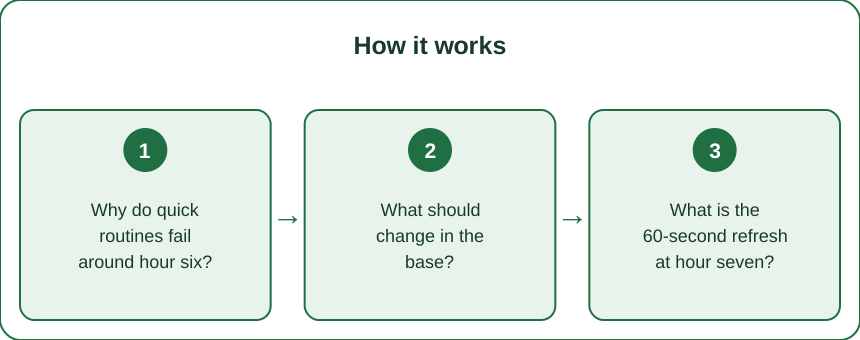
Why do quick routines fail around hour six?
Because most of them are optimized for immediate appearance rather than for adhesion.
Skin produces oil continuously, and oil breaks the bond between makeup and skin. Around hour five to seven, most people reach the point where enough oil has surfaced to lift a base that was applied to a clean, matte surface.
Movement compounds it. Touching your face, a phone against the cheek, a mask, glasses, expressions. The high-friction zones - around the nose, the chin, under the eyes - go first, which is why the failure looks patchy rather than uniform.
Temperature swings matter more than people think. Going from an air-conditioned office to a warm street repeatedly causes the skin to flush and cool, which affects how product sits.
And the classic error accelerates all of it. Applying more product at 7am to make it last longer produces a thicker layer with the same adhesion, which breaks up more visibly rather than less.
What should change in the base?
Grip over coverage. A base that adheres well in a thin layer outperforms a heavier base every time on a long day. If you use a primer, choose one designed for grip rather than blurring.
Skincare has to be fully absorbed. Applying base over damp or tacky skincare is one of the most common causes of a base that slides by noon. Give it two to three minutes, which you can spend on hair or coffee.
Cream first, powder second, and only where you need it. Cream blush and cream bronzer under a light dusting of powder outlast powder products applied alone, because the cream binds to skin and the powder locks it in place.
Powder only the T-zone and the high-friction areas. All-over powder on a 12-hour day makes the cheeks look dry by evening while doing nothing for the areas that actually break down.
Then one setting step. A setting spray applied at a distance and allowed to dry fully is the highest-return 20 seconds in the routine, and it is the step quick routines drop first.
What is the 60-second refresh at hour seven?
Three items, and the discipline to not add a fourth.
Blotting paper first, always. Press, do not rub. Removing surface oil before adding anything is what makes the refresh look fresh instead of layered.
Cream blush, tapped on with a finger. Color on the cheeks is what reads as awake. Cream over an existing base blends without disturbing what is underneath, whereas powder blush at hour seven catches on the day’s texture.
Lip. The single highest-impact item, and the one that has genuinely worn off by then rather than just faded.
What to skip: powder. Adding powder over a day of oil is what creates the heavy, tired look people are trying to fix. Blot instead.
What to skip: more base. Nothing looks more like a long day than a fresh layer of foundation applied over an eight-hour-old one.
A fourth optional item: a small amount of concealer under the eyes, applied sparingly and tapped in. Only if you genuinely need it, and only after blotting.
What Nobody Tells You About All-Day Wear
Long-wear formulas are harder to refresh. A base engineered for 16 hours of wear resists being blended over at hour seven, so a mid-range formula plus a good refresh often beats a transfer-proof formula with no refresh.
Your skin type at 7pm is not your skin type at 7am. Oily skin gets oilier and dry skin gets drier over a long day, so the routine that suits your morning skin may be exactly wrong for your evening skin. Building for the midpoint is more practical than optimizing for the start.
The under-eye is where a long day shows first, and it is where more product helps least. A thin layer that creases slightly beats a thicker one that creases significantly.
Setting spray needs to dry undisturbed. Applying it and immediately putting on a jacket or touching your face defeats the point. Thirty seconds of not touching your face is part of the step.
Hands are the biggest variable and nobody tracks it. The average person touches their face many times an hour without noticing. Cutting that in half does more for makeup longevity than any product on the list, which is a slightly deflating thing to learn after buying a setting spray.
FAQ: Long-Day Makeup Questions, Answered
Does more powder make it last longer?
No, past a light layer on the T-zone. Powder sets what is underneath; it does not extend adhesion, and excess powder is what makes the finish look dry and heavy by evening.
Is setting spray actually worth the step?
For a 12-hour day, yes. It is the single step with the best return on time in the routine, provided it is applied at a distance and allowed to dry fully.
What should I keep in my bag?
Blotting papers, one cream blush and a lip. Three items, small, and they cover the refresh completely. A powder compact is the item most often carried and least often helpful.
How do I stop makeup from breaking up around my nose?
That is a high-friction and high-oil zone. Use the least product there, set it lightly with powder, and blot rather than reapply during the day. It is the first place to break down on almost everyone and the last place that benefits from more coverage.
TL;DR:
- Long-day wear comes from adhesion, not coverage - a thin grippy base beats a heavy one.
- Let skincare absorb fully, use cream products under a targeted powder, and do not skip setting spray.
- Refresh at hour seven with blotting paper, cream blush and lip - never powder or more base.
- Powder only the T-zone, keep the under-eye thin, and touch your face less.
The five-minute routine does not need to become a fifteen-minute routine. It needs three of its five minutes moved to the layers underneath, plus 60 seconds somewhere around lunchtime.
Keep Reading
This article is for general informational and styling purposes only. Fit, sizing, and product availability may vary.