The Five-Minute Face for the Week the Heating Comes On
Quick Answer: Central heating drops indoor humidity substantially, and skin responds within a few days - more dehydration, more flaking, and makeup that clings to dry patches and separates by afternoon. Three adjustments handle it: add a hydrating step under whatever base you use, switch from powder-heavy to cream-based products, and change the order so that anything drying goes on last. The routine stays five minutes.
The heating came on Tuesday.
By Friday your foundation is catching on your cheeks and your under-eye is creasing by lunchtime.
Same products, same technique, different air.
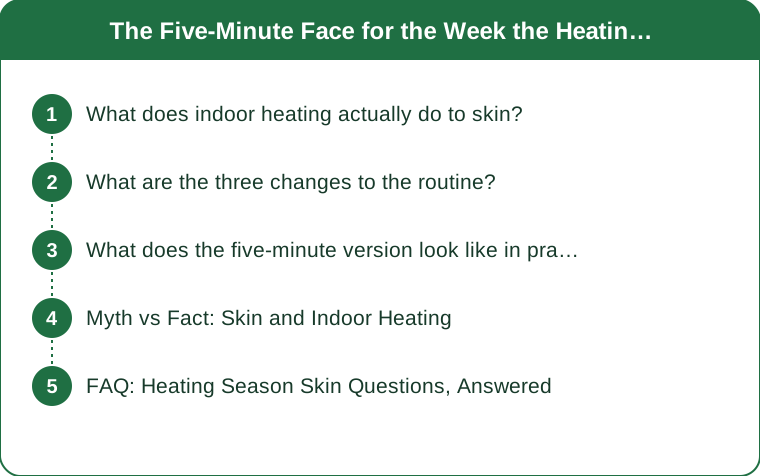
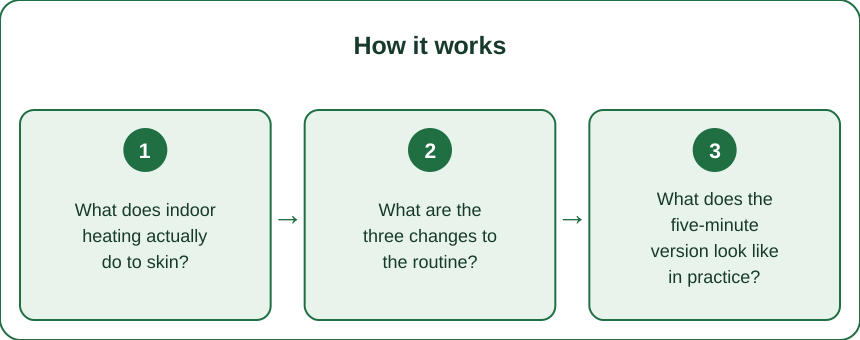
What does indoor heating actually do to skin?
It removes water from the air, and the skin loses water to the air continuously.
Heated indoor air holds much less relative humidity than the same air outdoors, and heating systems can drop indoor relative humidity into the 20-30% range in cold weather - substantially below the 40-60% that skin is comfortable in.
Skin loses water to the environment continuously through a process called transepidermal water loss, and the rate increases as the surrounding air gets drier. Dry air pulls water out faster than the skin barrier replaces it.
The visible consequences, roughly in order of appearance:
- Tightness, usually within days
- Flaking, particularly around the nose and on the cheeks
- Makeup clinging to dry patches and looking textured where it did not before
- Increased oil production in some people, which is a barrier response and is why dehydrated skin can look oily and feel tight at the same time
The temperature swing compounds it. Moving between a heated interior and cold outdoor air repeatedly stresses the barrier, and autumn is when that swing starts.
Which is why the change feels sudden. It is a barrier disruption happening over days rather than a gradual seasonal drift, and products formulated for summer skin behave differently on it almost immediately.
What are the three changes to the routine?
One added step, one product swap, one order change. Total added time: about thirty seconds.
### 1. Add a hydrating step before base
A hydrating serum or essence on damp skin, before moisturiser. Humectants like glycerin and hyaluronic acid draw water into the upper layers, and applying to damp skin gives them water to work with.
The critical detail: seal it with a moisturiser immediately. In very dry air, a humectant left unsealed can pull moisture out of the skin rather than into it, which is why some people find hyaluronic acid makes things worse in winter. It is an application problem, not a product problem.
### 2. Swap powder-heavy for cream-based
Powder products sit on top of dry patches and emphasise them. Cream products blend into the surface and reflect light more forgivingly.
Where the swap matters most:
- Blush - cream over powder is the single most noticeable improvement
- Bronzer and contour, for the same reason
- Setting powder - use much less, and only where you actually need it
### 3. Change the order so drying products go last
Anything mattifying or long-wear goes on after everything hydrating, and only where it is needed. Setting powder on the T-zone only rather than the whole face is usually enough, and full-face powder is the most common cause of the afternoon texture problem.
What does the five-minute version look like in practice?
Same length, slightly different sequence.
Minute one: hydrate. Hydrating serum on damp skin, then moisturiser over the top while the serum is still tacky. Do not wait for it to dry.
Minute two: let it settle, and do something else. This is the step most people skip and it matters more in dry conditions than at any other time of year. Base applied over moisturiser that has not absorbed slides and separates. Brush your teeth in the gap.
Minute three: base. A tinted moisturiser, skin tint or hydrating foundation applied with fingers or a damp sponge. Warm it in the hands first - product applied cold to cold skin sits on the surface rather than blending in.
Minute four: cream blush, cream bronzer if you use it, brows. Cream products applied over a cream base blend far more easily than powder over cream.
Minute five: eyes, lips, and targeted powder only. A small amount of powder on the T-zone if you need it, and nothing on the cheeks.
What to skip in dry conditions: full-face setting powder, matte long-wear formulas on the cheeks, and anything described as oil-control unless you genuinely need it.
One extra thing worth doing on the worst days: a facial mist after everything is on. It settles powder into the skin and removes the powdery look in about three seconds.
Myth vs Fact: Skin and Indoor Heating
Myth: Oily skin does not need extra hydration in winter. Fact: Dehydrated skin can produce more oil as a barrier response, which is why skin can feel tight and look shiny simultaneously. Oily skin still needs water; it needs less occlusive product.
Myth: Hyaluronic acid always helps in dry air. Fact: Unsealed humectants in very dry air can draw moisture from deeper skin layers outward. Applied to damp skin and sealed with a moisturiser, it works well. The application matters more than the ingredient.
Myth: More moisturiser is the answer. Fact: Piling on product without letting each layer absorb causes makeup to slide. Thin layers with brief waits work considerably better than one thick layer.
Myth: Setting powder makes makeup last longer. Fact: On dehydrated skin, full-face powder emphasises texture and often makes makeup break down faster by drawing moisture from the surface. Targeted use only.
Myth: You need a completely different routine for winter. Fact: Three adjustments to the same routine handle most of it. A total rebuild is rarely necessary and makes it harder to identify what actually helped.
Myth: A humidifier is an unnecessary gadget. Fact: Raising bedroom humidity toward 40-50% overnight addresses the cause rather than the symptom, and it is one of the higher-value changes for anyone whose skin struggles every winter.
FAQ: Heating Season Skin Questions, Answered
Why did my foundation stop working overnight?
The product did not change - the air did. Indoor heating drops humidity within days, and a base formulated to control oil behaves very differently on dehydrated skin. Adding a hydrating layer underneath usually restores it.
Is my skin dry or dehydrated?
Dry skin lacks oil and is usually a persistent skin type; dehydrated skin lacks water and is a temporary condition that anyone can get, including oily skin. Heating season causes dehydration, which is why oily skin can suddenly feel tight.
Should I switch to a heavier foundation?
Usually the opposite. Heavier coverage tends to emphasise texture on dehydrated skin. A lighter, more hydrating base over a properly prepped surface generally looks better than more product.
Do humidifiers actually help?
Yes, particularly overnight in the bedroom. Raising relative humidity toward 40-50% addresses the cause rather than compensating for it, and it tends to make the biggest difference of anything on this list.
Why is my under-eye creasing now when it did not in summer?
Dehydrated skin creases more readily, and the under-eye area has thinner skin and less oil to begin with. A hydrating eye product before concealer, and less powder over the top, usually resolves it.
How long does skin take to adjust to heating?
Usually a couple of weeks to stabilise at a new baseline, and it does not return to summer condition while the heating is on. The routine adjustments are for the season rather than for the transition.
TL;DR:
- Indoor heating can drop humidity to 20-30%, well below what skin is comfortable in, and the change shows within days
- Add a hydrating serum on damp skin and seal it with moisturiser immediately - unsealed humectants can backfire in dry air
- Swap powder blush and bronzer for cream versions; it is the single most visible improvement
- Powder goes on last and only on the T-zone, never full face
- Let moisturiser absorb before base - the skipped wait causes most of the sliding
- A facial mist at the end removes the powdery look in seconds
- A bedroom humidifier addresses the cause rather than the symptom
The products did not stop working. The air changed, and three adjustments are enough.
Keep Reading
This article is for general informational and styling purposes only. Fit, sizing, and product availability may vary.