The Makeup Bag Autopsy: Decluttering Products Past Their Prime
Quick Answer: The small open-jar icon on cosmetics shows the shelf life after opening, not after purchase. Mascara is 3 months, liquid foundation about 12, powders 24, lipstick 18-24. Toss anything separated, smelly, or texture-changed on sight, keep the eight or so products you actually use, and write the opening date on everything new.
Somewhere in that bag is a lipstick from a previous chapter of your life and a mascara old enough to have formed opinions.
Makeup expires, and not as a marketing invention — as microbiology. The annual bag autopsy is partly hygiene and, surprisingly often, a genuine relief.
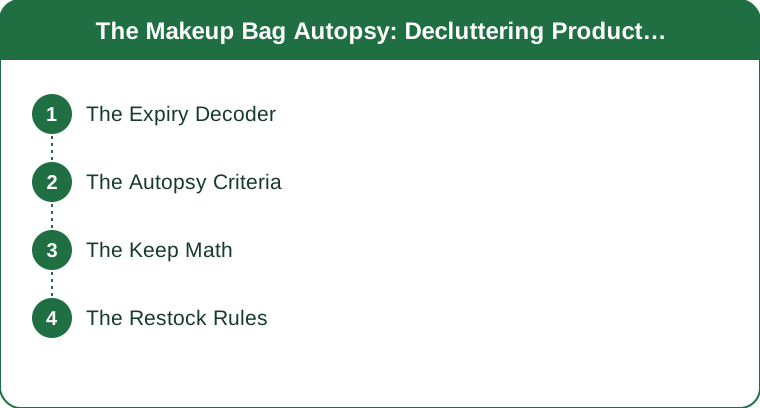
How Do You Read a Makeup Expiry Date?
Look for the small open-jar icon, usually on the back or base. The number next to it — 6M, 12M, 24M — is the period after opening, not shelf life from manufacture.
That distinction matters enormously. An unopened foundation can sit in a drawer for two years and be fine; the same foundation opened two years ago is not.
Typical windows:
- Mascara and liquid eyeliner — 3 months. Eye bacteria keep short calendars, and the wand reintroduces them with every use.
- Liquid and cream foundation — 6 to 12 months. Pump bottles last longer than open-neck ones because less air gets in.
- Cream blush and concealer — 12 months.
- Powders — 24 months. No water content means far less to grow in.
- Lipstick — 18 to 24 months. Or sooner, if it starts smelling faintly of crayons.
- Sunscreen — go by the actual printed expiry date, and don’t push it. That one is a performance question, not just a hygiene one.
What Should Get Thrown Out Immediately?
Five things, no deliberation required.
Anything separated. Foundation or liquid product that’s split into layers and won’t remix has broken its emulsion. It won’t apply evenly again.
Anything that smells different. A change in smell is the most reliable spoilage signal there is, across every product type. Trust it over the date.
Anything with a changed texture. Grainy cream, crumbly powder, a lipstick that’s gone waxy or sweaty. The formula has degraded.
Any eye product past its window. This is the category worth being strict about, because the eye is where contaminated product actually causes problems — irritation, styes, and conjunctivitis all trace back here.
Anything you can’t date. If you have to stop and think about when you bought it, the thinking is the answer.
Add a sixth for anything that was used while you had an eye infection. That one goes regardless of age.

What Actually Survives the Purge?
Fewer things than you’d guess, and that’s the good news.
Most people find that around eight products do roughly 95% of the work — a base, a concealer, one blush, a brow product, a mascara, one or two lip products, and a setting powder. Everything else is either aspirational or a duplicate of something better.
A useful sorting question isn’t “would I ever use this?” It’s “when did I last actually reach for it?” Aspirational products fail the second question instantly.
The five-minute face was always running on a small roster. The purge just makes the bag admit it, which incidentally makes getting ready faster — less digging, fewer decisions, no rummaging past twelve things you don’t want.
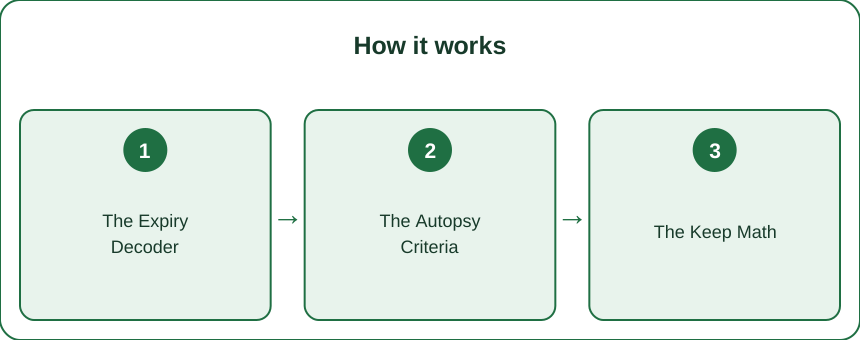
What Nobody Tells You About Makeup Expiry
Brushes and sponges expire too, in their own way. Sponges should be replaced every 1 to 3 months and washed after every few uses. Brushes last years if you wash them monthly — bacteria on a dirty brush shortens the life of every product it touches.
Where you store it changes the timeline. The bathroom is the worst place for makeup: heat and humidity accelerate degradation considerably. A bedroom drawer is meaningfully better.
Double-dipping shortens everything. Fingers into a cream pot introduce bacteria directly. A small spatula or a clean brush adds months to a product’s usable life.
Natural and preservative-free formulas expire faster, not slower. Preservatives are the reason conventional makeup lasts as long as it does — removing them is a trade, not a pure upgrade.
And the sunk-cost trap is strongest with expensive products. The £40 foundation that doesn’t suit you isn’t worth using because it was expensive; it’s costing you the good version of getting ready every single morning.
How Do You Keep the Bag From Refilling?
Four small rules, and this is the part that makes the twenty minutes stick.
- Write the opening date on every new product. A tiny sticker or a permanent marker on the base. It removes all future guesswork.
- Buy small sizes of anything you use rarely. A full-size product you use monthly will expire long before it’s finished.
- One in, one out. The same rule that governs the closet works here, and the bag is a much smaller space to enforce it in.
- Do this annually. Put it in the calendar next to the smoke alarm batteries — it’s the same kind of task.
Mini FAQ
How long does mascara really last?
Three months from opening. The wand travels between your lash line and an enclosed dark tube repeatedly, which is close to ideal conditions for bacteria. This is the one timeline worth being strict about.
Can you use expired makeup if it looks fine?
Powders are relatively low-risk past their date. Anything liquid, cream, or used near the eyes is not worth it — degraded preservatives can allow growth well before there’s any visible change.
Where should you store makeup?
A cool, dry, dark spot — a bedroom drawer rather than a bathroom shelf. Heat and humidity noticeably shorten the life of most formulas.
TL;DR:
- The open-jar icon counts from opening, not purchase — 3M mascara, 12M foundation, 24M powders.
- Toss on sight: separated, smelly, texture-changed, undateable, or any past-window eye product.
- Roughly eight products do 95% of the work; keep those and let the rest go.
- Store in a bedroom drawer, not the bathroom, and stop double-dipping with fingers.
- Date every new product and repeat the audit annually.
Twenty minutes, and you get back a bag where everything in it is safe, current, and actually yours.
Keep Reading
This article is for general informational and styling purposes only. Fit, sizing, and product availability may vary.