The Five Minute Face for a 6am Flight
Quick Answer: Do skincare at home, makeup at the destination. Cabin humidity sits around 10-20% - drier than most deserts - so anything you apply at 5am is working against dehydration for the entire flight. The five minute version: cleanse and heavy moisturiser at home, SPF, concealer and brow only, then a 90-second refresh before landing. Skip powder foundation entirely; it is the single worst product choice for a dry cabin.
An early flight breaks the usual routine in three ways at once - you are applying it earlier than your skin is ready, wearing it far longer than a normal day, and doing it in an environment specifically designed to dry everything out.
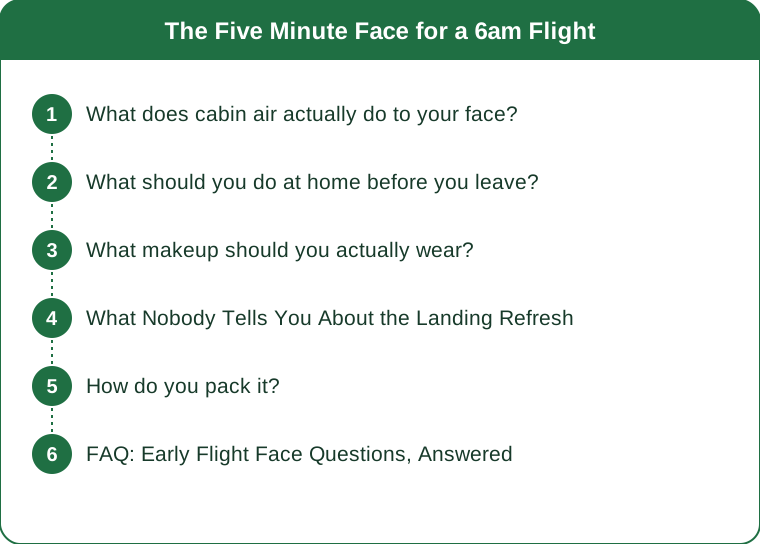
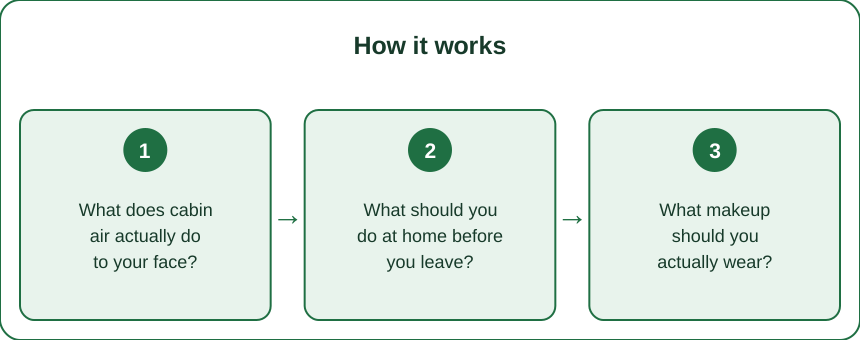
What does cabin air actually do to your face?
Three things, and they compound over the length of the flight.
Humidity drops to roughly 10-20%. For comparison, a comfortable indoor environment is 40-60%. Your skin loses water to the air continuously through transepidermal water loss, and the drier the air, the faster it goes.
Dehydrated skin overproduces oil. This is the part that surprises people who expect to land looking dry. Barrier disruption triggers compensatory sebum production, which is why so many people land with a face that is simultaneously tight and shiny.
The pressure change affects circulation and fluid distribution. Cabins are pressurised to the equivalent of roughly 6,000-8,000 feet. The result is mild puffiness, particularly around the eyes, and it is worse on an early flight because you have been horizontal recently.
So the face you are trying to make presentable at 5am is going to be a dehydrated, slightly oily, mildly puffy version of itself by the time anyone sees it. Building the routine around that end state rather than the starting one is the whole trick.
What should you do at home before you leave?
Skincare only, and be more generous than usual.
Cleanse gently. A cream or milk cleanser, not a foaming one. You are about to spend hours in dry air and there is no reason to strip anything first.
Layer a humectant under an occlusive. A hyaluronic acid serum on damp skin, then a thicker moisturiser or balm over the top. The order matters: a humectant pulls water in, an occlusive stops it leaving. A humectant alone in a very dry cabin can actually pull moisture out of your skin, which is the opposite of what you want.
SPF, properly. UV exposure at altitude is higher, and window seats get direct sun for hours. This is not optional on a daytime flight.
Balm on the lips and around the nose. Both go first and both are the most visible.
Skip eye cream if you are prone to puffiness. Rich eye creams plus cabin pressure plus a 4am start is a reliable recipe for looking more tired than you are. A light gel or nothing is better.
What makeup should you actually wear?
As little as possible on the way, with the real routine saved for the last twenty minutes.
The minimum viable face for the airport:
Concealer, only where you need it. Under-eyes and any spots. A hydrating liquid formula, patted rather than blended, in a thin layer. Nothing full-coverage.
Brows. This is the highest return item on the list by a distance. Groomed brows do more for looking put together than anything else you could apply, and they do not degrade over six hours.
A cream blush or tinted balm on the cheeks. Cream over powder, always - it stays flexible on dry skin instead of clinging to flakes.
That is it. No foundation, no powder, no mascara if you plan to sleep.
What to specifically avoid: powder foundation is the worst choice for cabin air; it accentuates every dry patch and there is nowhere for it to go but into fine lines. Long-wear matte liquid lipstick is the second worst - it is drying by design and the cabin finishes the job.
What Nobody Tells You About the Landing Refresh
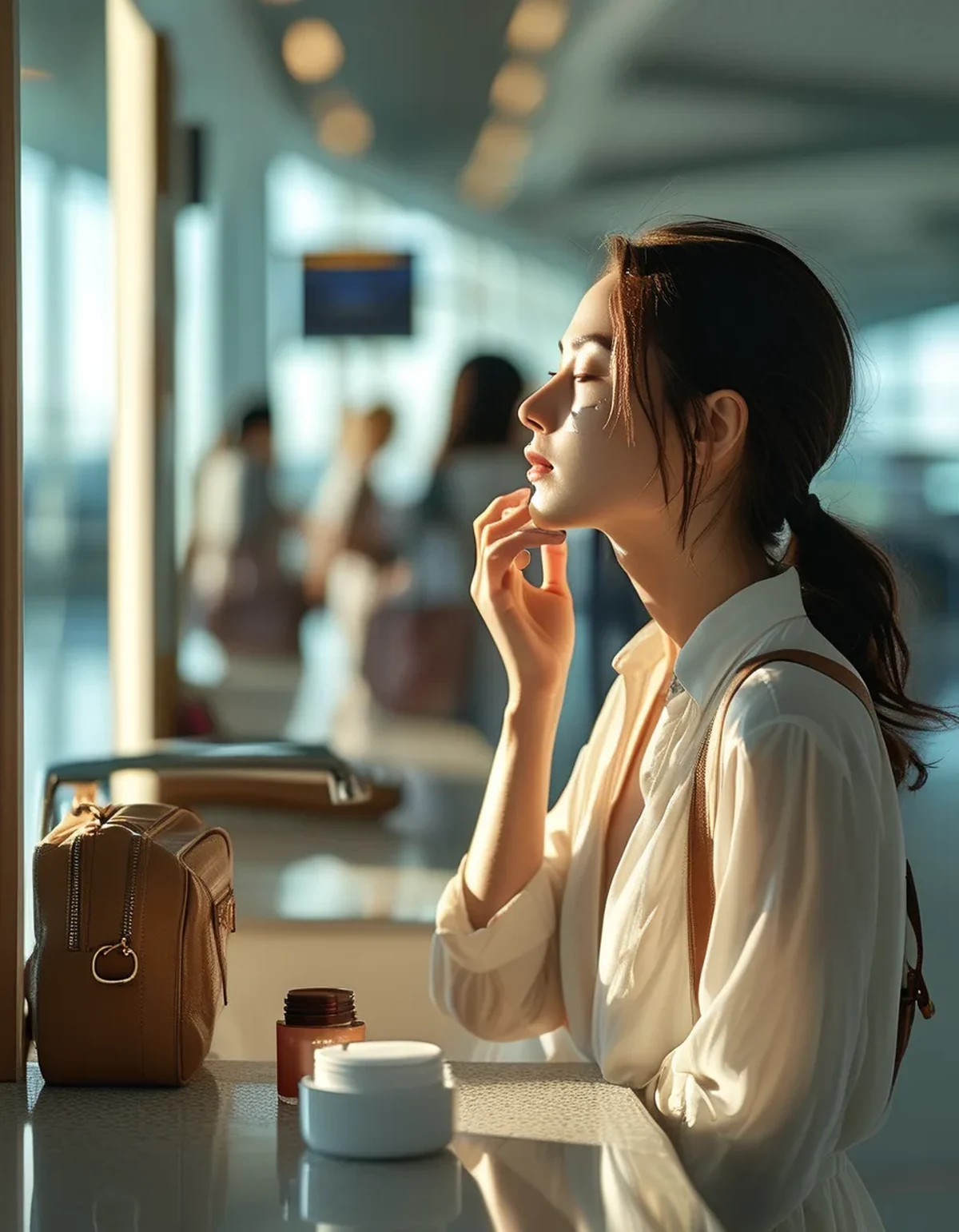
The 90 seconds before landing does more for how you look than everything you did at 5am, and almost nobody plans for it.
By this point your face has been through six hours of dry air. Anything applied at home has settled, separated, or absorbed. The refresh is not a touch-up - it is when you actually do your face.
The sequence, in order:
Mist or damp cloth first. Rehydrate the surface before you add anything. A small facial mist is the single most useful thing in a travel pouch.
A pea of moisturiser, pressed in. Not rubbed. This resets the base and it takes fifteen seconds.
Cream blush and a lip. Colour is what reads as awake. This is where the visible change happens.
Concealer only if genuinely needed, and less than you think - the skin has plumped slightly from the mist.
Mascara last, if you want it.
Do it at your seat, not in the toilet. The lighting is better, there is no queue, and you have a tray table. The only thing worth the toilet trip is a proper hand wash beforehand.
How do you pack it?
One small pouch, and the constraint is what survives being carried rather than what you would ideally use.
Everything under 100ml and in the clear bag if it is liquid. A full-size mist will be confiscated; a 50ml one will not.
Choose sticks and balms over anything in a pot or a pump. Cabin pressure changes push product out of pumps and droppers - this is a real and messy phenomenon, not a myth. Put anything with a pump in a zip bag, and prefer sticks where a stick version exists.
The seven-item pouch: cream cleanser wipe or micellar pad, mini moisturiser, mini mist, SPF stick, concealer, cream blush stick, tinted lip balm. Brows if you use a pencil rather than a gel.
Decant into small containers rather than buying travel sizes of everything. It is cheaper and it means you are using the products your skin already tolerates - which matters more on a travel day, when your barrier is already stressed.
Keep the pouch in the seat pocket, not the overhead. The refresh only happens if the bag is within reach when the seatbelt sign comes on.
FAQ: Early Flight Face Questions, Answered
Should I wear makeup on the flight at all?
If you are going straight to a meeting, yes - the minimum version above. If you have any buffer at the other end, bare skin plus a good moisturiser genuinely lands better, and it is what most frequent travellers end up doing.
Do sheet masks on a plane work?
They work, and the humectants can backfire in very dry air unless you seal with a moisturiser afterwards. A thick balm does most of the same job with none of the awkwardness.
What about a red-eye rather than an early morning?
Same principles, one change: skip everything except cleansing and a heavy balm, sleep, then do the full landing refresh. An overnight flight is the easiest case because nobody expects a face until you are on the ground.
TL;DR:
- Skincare at home, makeup before landing. Cabin air at 10-20% humidity undoes anything applied at 5am.
- Humectant under an occlusive - a serum alone in dry air can pull moisture out of your skin.
- On the way: concealer, brows, cream blush. No powder, no matte liquid lipstick.
- The 90-second landing refresh is the real routine: mist, moisturiser, cream colour, mascara last.
- Sticks and balms over pumps and pots, and keep the pouch in the seat pocket.
An early flight is not a five minute face done faster. It is a five minute face split into two two-minute halves, six hours apart - and the second half is the one that counts.
Keep Reading
This article is for general informational and styling purposes only. Fit, sizing, and product availability may vary.